
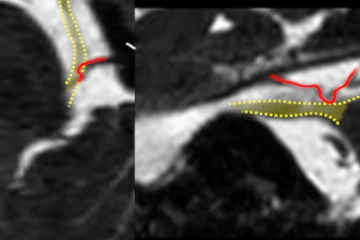
Trigeminal neuralgia is a severe, paroxysmal facial pain disorder characterized by recurrent, unilateral, electric shock-like episodes in the distribution of one or more branches of the trigeminal nerve, often triggered by innocuous stimuli such as light touch, chewing, or talking. The pain is abrupt in onset and termination, and attacks can last seconds to minutes, profoundly affecting quality of life.
Epidemiology
The incidence is estimated at 4–13 per 100,000 per year, with increased prevalence in women and older adults. Most cases are idiopathic or classical, with a minority due to secondary causes such as multiple sclerosis or tumors.
Clinical presentation
Patients present with brief, intense, unilateral facial pain, typically in the V2 or V3 distribution. Pain attacks are often triggered by light touch, such as shaving, chewing, applying makeup, showering, or even a gust of wind. Pain attacks can last from less than a second to two minutes and may occur occasionally many times a day – up to 100 in severe cases. Pain attack episodes can persist for weeks or months, with long pain-free periods in between.
Neurological examination is usually normal in classical TN; sensory deficits suggest secondary TN. Continuous pain or atypical features may indicate a poorer prognosis or alternative diagnosis.
- Classic trigeminal neuralgia occurs when a blood vessel, usually an artery (loop), presses on the nerve.
- Secondary trigeminal neuralgia occurs as a result of another disease, such as multiple sclerosis, benign or malignant tumors or a stroke. These diseases can lead to irritation of the trigeminal nerve.
- Idiopathic trigeminal neuralgia has a cause that cannot be precisely determined. As well here, the pain is caused by an irritated nerve.
Radiological findings
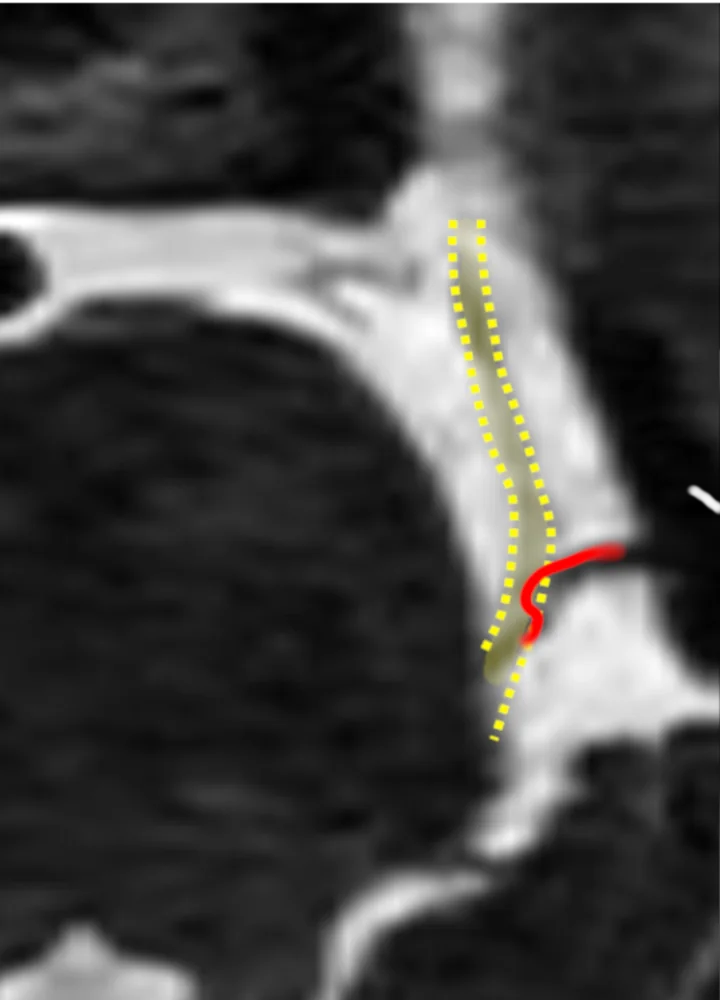
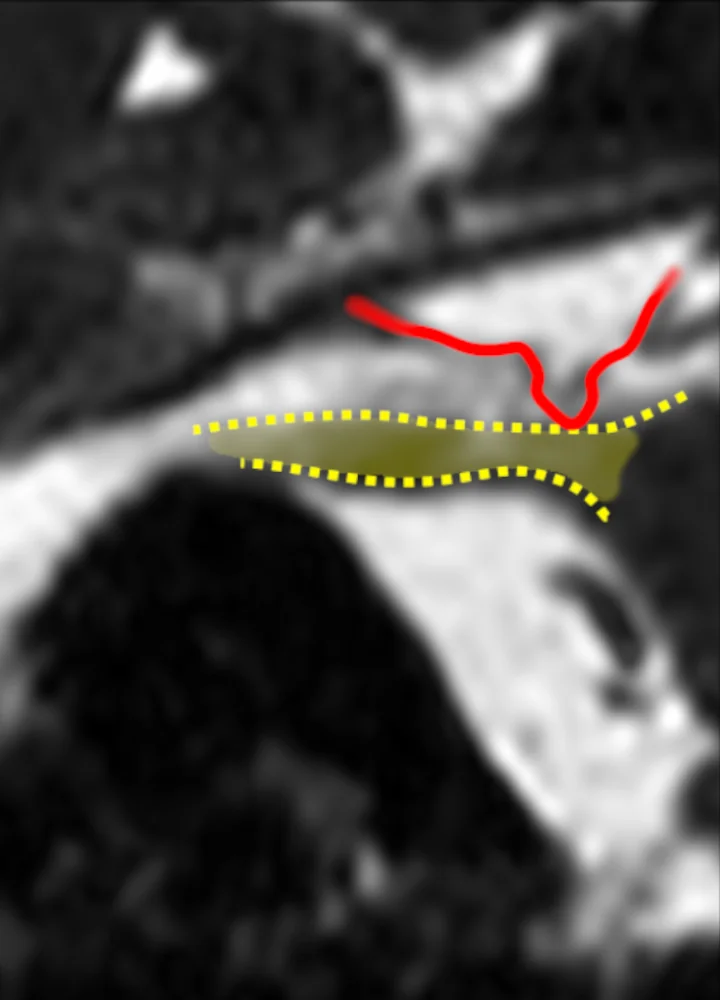
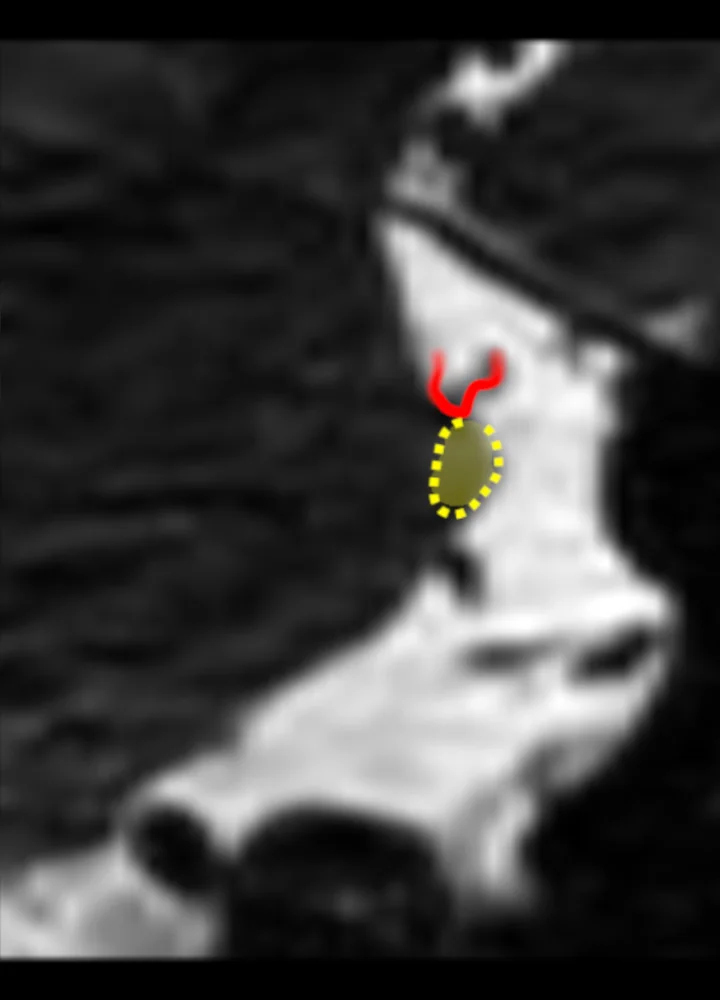
High-resolution MRI is recommended to exclude secondary causes and to identify neurovascular compression. Classical TN is associated with neurovascular contact causing morphological changes (distortion, displacement, or atrophy) of the trigeminal nerve root. Advanced imaging (e.g., diffusion tensor imaging) may show focal demyelination, but conventional MRI is sufficient for most cases.
Differential diagnoses
- Cluster headaches
Non-surgical treatment
If a potential surgically removable tumor is ruled out, it is always worth trying to treat it with medication. The drugs used mostly come from the group of antiepileptic drugs, have a membrane-stabilizing effect. This can raise the stimulation threshold for the pain fibres of the trigeminal nerve.
The medication carmamazepine or alternatively oxcarbazepine is gradually increased in tolerated dosage. Lamotrigine, gabapentin, phenytoin and other drugs may be tried as well.
Indication for surgery
Surgery is indicated for patients with medically refractory TN (failure or intolerance of carbamazepine/oxcarbazepine) or those with disabling symptoms.
Microvascular decompression according to Jannetta
Microvascular decompression is preferred in classical TN with a confirmed neurovascular conflict and in patients without major comorbidities.
Side effect or complications:
- Common: localized numbness at the back of the head, temporary pain in the surgical area, temporary dizziness and/or nausea
- Rarely: hearing loss, loss of sensation in the face
- Very rare: wound infection, cerebral hemorrhage
Rhizotomy of the ganglion gasseri
Percutaneous procedures (radiofrequency thermocoagulation, balloon compression, glycerol injection) are considered for elderly or high-risk patients, when MRI does not show vascular contact or microvascular decompression has failed.
Side effect or complications:
- Frequent: temporary numbness in the face
- Rare: a permanent feeling of numbness in the face
- Very rare: other complications
- Severe complications
– “Anesthesia dolorosa”: This is a complete numbness of the face accompanied by pain.
– Blindness due to damage to the cornea. This occurs when the eye is numb and its protective reflexes no longer function as usual.
Radiosurgical treatment
The procedure is a good alternative to rhizotomy and is particularly suitable for patients with contraindications to surgery. In a single-stage stereotactic setting, irradiation of the trigeminal nerve is performed with a very high radiation dose of 70 to 80 gray.
Side effect or complications:
- Permanent facial numbness is around 20%
Outcome
Microvascular decompression:
Immediate pain relief in 80 to 96% of cases and between 72 and 85% of patients still pain-free 5 years after the procedure without the need for any medication.
Rhizotomy of the ganglion gasseri:
Initial success is expected in around 80 to 95% of cases with 65 to 80% of patients still pain-free after 5 years (depending on the procedure used).
Radiosurgical treatment:
The pain-relieving effect only occurs several weeks after treatment. The chance of success is not quite as good as with the other procedures. 92 to 97% of patients initially and only 44 to 65% after 5 years stay pain-free.
References
- Trigeminal Neuralgia. Ashina S, Robertson CE, Srikiatkhachorn A, et al. Nature Reviews. Disease Primers. 2024;10(1):39. doi:10.1038/s41572-024-00523-z.
- 13. Trigeminal Neuralgia. Snel BJ, Cohen SP, Erdine S, et al. Pain Practice : The Official Journal of World Institute of Pain. 2025;25(5):e70051. doi:10.1111/papr.70051.
- Advances in Diagnosis, Classification, Pathophysiology, and Management of Trigeminal Neuralgia. Bendtsen L, Zakrzewska JM, Heinskou TB, et al. The Lancet. Neurology. 2020;19(9):784-796. doi:10.1016/S1474-4422(20)30233-7.
- Trigeminal Neuralgia. Cruccu G, Di Stefano G, Truini A. The New England Journal of Medicine. 2020;383(8):754-762. doi:10.1056/NEJMra1914484.
- A Comprehensive Review of Trigeminal Neuralgia. Jones MR, Urits I, Ehrhardt KP, et al. Current Pain and Headache Reports. 2019;23(10):74. doi:10.1007/s11916-019-0810-0.
- Trigeminal Neuralgia: The Diagnosis and Management of This Excruciating and Poorly Understood Facial Pain. Zakrzewska JM, McMillan R. Postgraduate Medical Journal. 2011;87(1028):410-6. doi:10.1136/pgmj.2009.080473.